
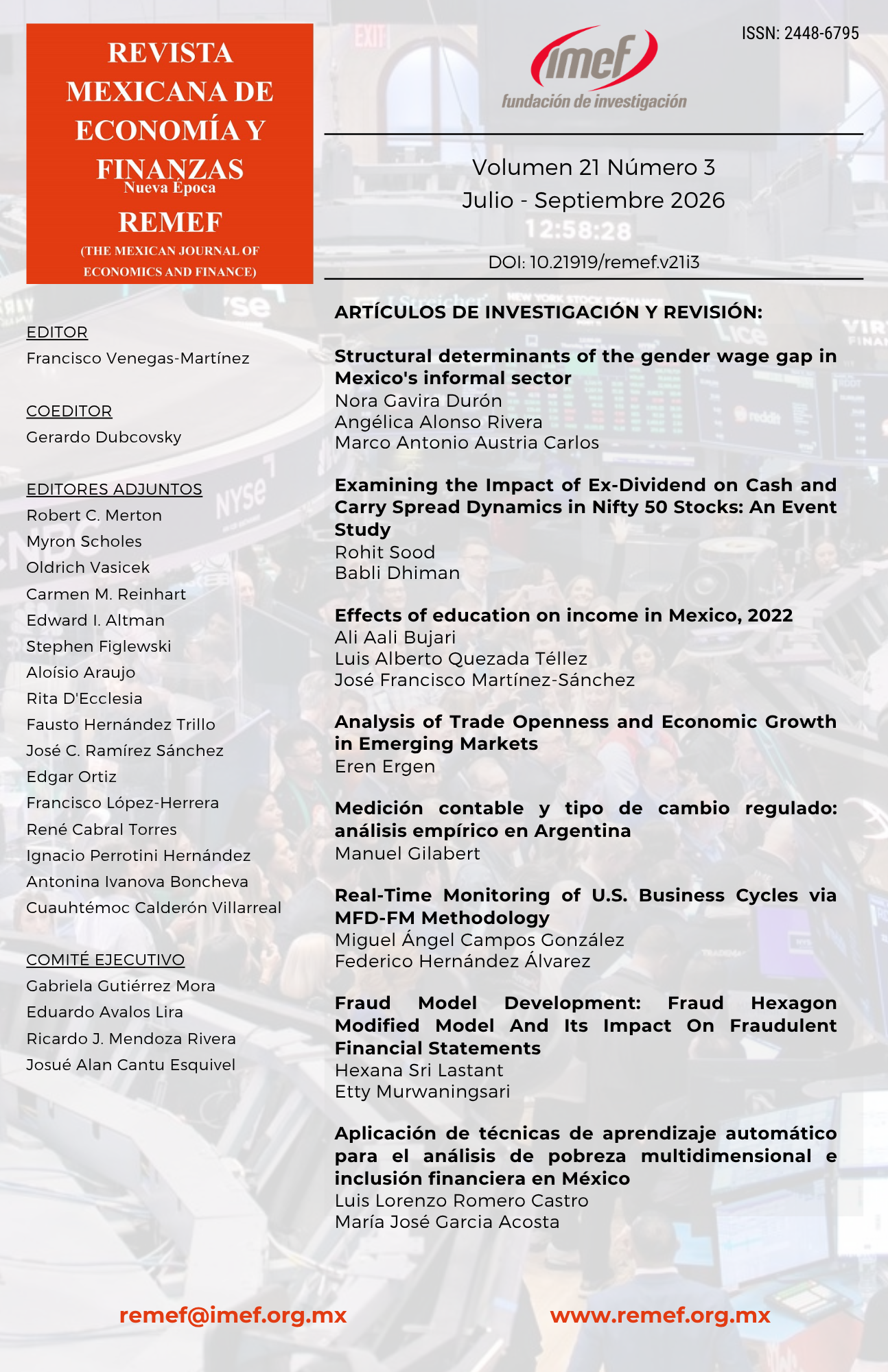
Real-Time Monitoring of U.S. Business Cycles via MFD-FM Methodology
DOI:
https://doi.org/10.21919/remef.v21i3.1369Palabras clave:
Ciclos económicos, Nowcasting, Modelo de factores dinámicos, Datos de frecuencia mixta, Filtro de KalmanResumen
Monitoreo en Tiempo Real de los Ciclos Económicos de Estados Unidos mediante la Metodología MFD-FM
El objetivo de este estudio es desarrollar un esquema de monitoreo en tiempo real del ciclo económico de Estados Unidos mediante un Modelo de Factores Dinámicos de Frecuencias Mixtas (MFD-FM). La metodología integra el PIB trimestral con indicadores macroeconómicos mensuales (inflación (CPI), tasa de interés, índice de precios de vivienda (HPI) y tasa de participación laboral (LFPR)) en una formulación de espacio de estados estimada con el filtro de Kalman, a partir de la cual se obtiene un factor común representativo de la actividad económica agregada. Los resultados muestran que el factor captura los cambios cíclicos y anticipa episodios de contracción y recuperación asociados a shocks recientes. El enfoque puede emplearse como herramienta de vigilancia macroeconómica y apoyo a la toma de decisiones bajo incertidumbre. Como limitación, se requiere validación adicional bajo distintos conjuntos de variables y contextos nacionales, lo que implica potenciales ajustes por quiebres estructurales y disponibilidad de datos.
Citas
Aruoba, S. B., & Diebold, F. X. (2010). Real-time macroeconomic monitoring: Real activity, inflation, and interactions. American Economic Review, 100(2), 20–24. https://doi.org/10.1257/aer.100.2.20
Aruoba, S. B., Diebold, F. X., & Scotti, C. (2011). Globalization, the business cycle, and macroeconomic monitoring. International Monetary Fund Working Paper No. 11/25. https://doi.org/10.5089/9781455216727.001
Bailey, M. A. (2020). Real econometrics: The right tools to answer important questions (2nd ed.). Oxford University Press.
Bańbura, M., Giannone, D., & Reichlin, L. (2011). Nowcasting. In M. P. Clements & D. F. Hendry (Eds.), The Oxford handbook of economic forecasting (pp. 63–90). Oxford University Press. https://doi.org/10.1093/oxfordhb/9780195398649.013.0008
Borio, C. (2014). The financial cycle and macroeconomics: What have we learnt? Journal of Banking & Finance, 45, 182–198. https://doi.org/10.1016/j.jbankfin.2013.07.031
Camacho Ardila, A. G., Hernández Álvarez, F., & Román de la Sancha, L. I. (2023). Ciclos en el sector bancario mexicano: Un índice coincidente (CP1G7) vía ACP. Revista Mexicana de Economía y Finanzas, Nueva Época, 18(4), 1–25. https://doi.org/10.21919/remef.v18i4.926
Camacho, M., & Pérez-Quirós, G. (2010). Introducing the EURO-STING: Short-term indicator of euro area growth. Journal of Applied Econometrics, 25(4), 663–694. https://doi.org/10.1002/jae.1174
Cantú Esquivel, J. A., Ríos Bolívar, H., & Jiménez Preciado, A. L. (2022). Causalidad y acoplamiento cíclico entre variables macroeconómicas en la conformación de crisis financieras. Revista Mexicana de Economía y Finanzas, 18(1). https://doi.org/10.21919/remef.v18i1.669
Delajara, M., Hernández Álvarez, F., & Rodríguez Tirado, A. (2016). Nowcasting Mexico’s short-term GDP growth in real time: A factor model versus professional forecasters. Economía, 17(1), 167–182. https://doi.org/10.1353/eco.2016.a634035
Dai, Z., Zhang, X., & Liang, C. (2024). Efficient predictability of oil price: The role of VIX-based panic index shadow line difference. Energy Economics, 129, 107234. https://doi.org/10.1016/j.eneco.2023.107234
Doz, C., Giannone, D., & Reichlin, L. (2011). A two-step estimator for large approximate dynamic factor models based on Kalman filtering. Journal of Econometrics, 164(1), 188–205. https://doi.org/10.1016/j.jeconom.2011.02.012
Durbin, J., & Koopman, S. J. (2012). Time series analysis by state space methods (2nd ed.). Oxford University Press. https://doi.org/10.1093/acprof:oso/9780199641178.001.0001
Forni, M., Hallin, M., Lippi, M., & Reichlin, L. (2000). The generalized dynamic factor model: Identification and estimation. Review of Economics and Statistics, 82(4), 540–554.
Giannone, D., Reichlin, L., & Small, D. (2008). Nowcasting: The real-time informational content of macroeconomic data. Journal of Monetary Economics, 55(4), 665–676. https://doi.org/10.1016/j.jmoneco.2008.05.010
Gilbert, T., Scotti, C., Strasser, G., & Vega, C. (2017). Is the intrinsic value of macroeconomic news announcements related to their asset price impact? Journal of Monetary Economics, 92, 68–85. https://doi.org/10.1016/j.jmoneco.2017.09.008
Griliches, Z. (1974). Errors in variables and other unobservables. Econometrica, 42, 971. https://doi.org/10.2307/1914213
Hamilton, J. D. (1994). Time series analysis. Princeton University Press. https://doi.org/10.1515/9780691218632
Harvey, A. C. (1990). Forecasting, structural time series models and the Kalman filter. Cambridge University Press. https://doi.org/10.1017/CBO9781107049994
Heath, J. (2012). Lo que indican los indicadores: Cómo utilizar la información estadística para entender la realidad económica de México. INEGI.
Hu, Y.-P., & Chou, R.-J. (2003). A dynamic factor model. Journal of Time Series Analysis, 24(5), 529–538. https://doi.org/10.1111/1467-9892.00320
Inoue, A., & Kilian, L. (2006). On the selection of forecasting models. Journal of Econometrics, 130, 273–306. https://doi.org/10.1016/j.jeconom.2005.03.003
Kalman, R. E. (1960). A new approach to linear filtering and prediction problems. Journal of Basic Engineering, 82(1), 35–45. https://doi.org/10.1115/1.3662552
Koopman, S. J., Shephard, N., & Doornik, J. A. (1999). Statistical algorithms for models in state space using SsfPack 2.2. Econometrics Journal, 2(1), 107–160. https://doi.org/10.1111/1368-423X.00023
Mariano, R. S., & Murasawa, Y. (2003). A new coincident index of business cycles based on monthly and quarterly series. Journal of Applied Econometrics, 18(4), 427–443. https://doi.org/10.1002/jae.695
Peña, D., & Box, G. E. P. (1987). Identifying a simplifying structure in time series. Journal of the American Statistical Association, 82(399), 836–843.
Pontes, E. L., Benjannet, M., & Yung, R. (2024). Forecasting four business cycle phases using machine learning: A case study of U.S. and Eurozone. arXiv. https://doi.org/10.48550/arXiv.2405.17170
Proietti, T., & Giovannelli, A. (2021). Nowcasting monthly GDP with big data: A model averaging approach. Journal of the Royal Statistical Society: Series A, 184(2), 683–706. https://doi.org/10.1111/rssa.12645
Reinhart, C. M., & Rogoff, K. S. (2009). The aftermath of financial crises. American Economic Review, 99(2), 466–472. https://doi.org/10.1257/aer.99.2.466
Román de la Sancha, L. I., Hernández Álvarez, F., & Rodríguez García, G. (2019). Co-movimientos entre los índices accionarios y los ciclos económicos de Estados Unidos y México. Revista Mexicana de Economía y Finanzas, Nueva Época, 14(4), 695–714. https://doi.org/10.21919/remef.v14i4.352
Stock, J. H., & Watson, M. W. (1991). A probability model of the coincident economic indicators. In Leading economic indicators: New approaches and forecasting records (pp. 63–90). Cambridge University Press. https://doi.org/10.1017/CBO9781139173735.005
Stock, J. H., & Watson, M. W. (2002). Forecasting using principal components from a large number of predictors. Journal of the American Statistical Association, 97(460), 1167–1179. https://doi.org/10.1198/016214502388618960
Stundziene, A., Startiene, G., & Snieska, V. (2023). Future directions in nowcasting economic activity: A systematic literature review. Journal of Economic Surveys, 37(3), 820–851. https://doi.org/10.1111/joes.12579
Sun, W., Wang, Y., Zhang, L., Chen, X. H., & Hoang, Y. H. (2025). Enhancing economic cycle forecasting based on interpretable machine learning and news narrative sentiment. Technological Forecasting and Social Change, 215, 124094. https://doi.org/10.1016/j.techfore.2025.124094
Tenreiro Machado, J., Duarte, F., & Duarte, G. (2012). Analysis of stock market indices with multidimensional scaling and wavelets. Mathematical Problems in Engineering, 2012, 1–14. https://doi.org/10.1155/2012/819503
Varian, H. R. (2014). Big data: New tricks for econometrics. Journal of Economic Perspectives, 28, 3–28. https://doi.org/10.1257/jep.28.2.3
Wang, B., & Xiao, Y. (2023). The term effect of financial cycle variables on GDP growth. Journal of International Money and Finance, 139, 102970. https://doi.org/10.1016/j.jimonfin.2023.102970
Yang, J., Dong, D., & Liang, C. (2024). Climate policy uncertainty and the U.S. economic cycle. Technological Forecasting and Social Change, 202, 123344. https://doi.org/10.1016/j.techfore.2024.123344
Zhang, X. (2024). Country-level energy-related uncertainties and stock market returns: Insights from the U.S. and China. Technological Forecasting and Social Change, 204, 123437. https://doi.org/10.1016/j.techfore.2024.123437
Descargas
Publicado
Número
Sección
Licencia
Derechos de autor 2026 Revista Mexicana de Economía y Finanzas Nueva Época REMEF

Esta obra está bajo una licencia internacional Creative Commons Atribución-NoComercial 4.0.
Todos los Derechos Reservados © 2019 IMEF | Aviso de Privacidad IMEF | Información Legal

Este obra está bajo una licencia de Creative Commons Reconocimiento-NoComercial 4.0 Internacional.