
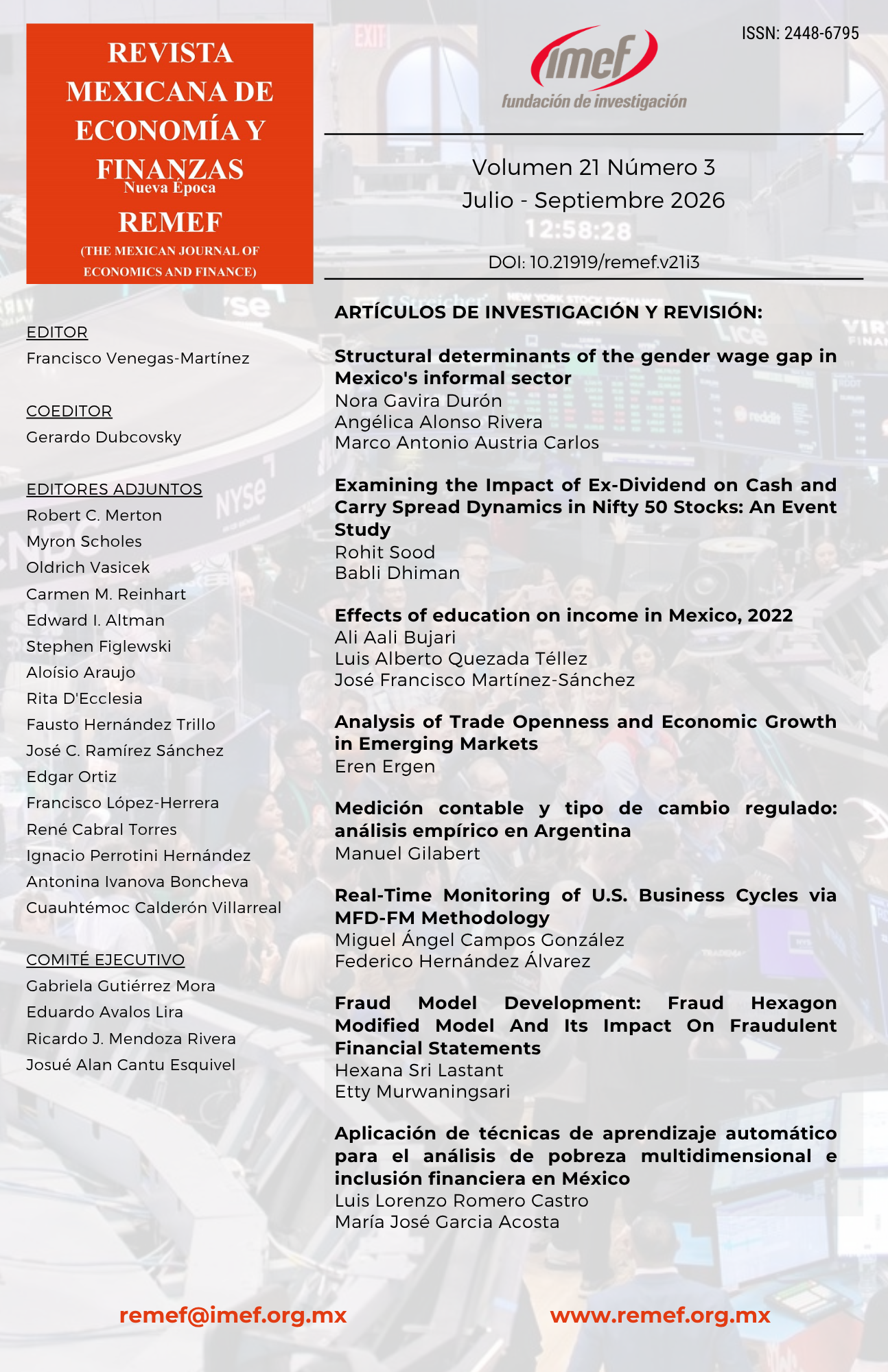
Medición contable y tipo de cambio regulado: análisis empírico en Argentina
DOI:
https://doi.org/10.21919/remef.v21i3.1304Keywords:
NIC 21, exchange rate gap, foreign exchange rate, financial statementAbstract
Accounting Measurement and Regulated Exchange Rate: Empirical Analysis in Argentina
This study aims to evaluate the accounting impact of the exchange rate gap on the valuation of financial statement items of companies listed on BYMA, comparing the official exchange rate (TCO) with the MEP rate in accordance with the exchangeability criterion introduced by IAS 21 (2023). The methodology is quantitative, descriptive, and cross‑sectional, complemented by non‑parametric inferential tests and a regression model with controls for net foreign currency exposure and firm size. The results show heterogeneous and materially significant effects, including cases in which the use of the MEP rate reverses the sign of earnings or equity. It is recommended that preparers consider alternative rates and disclose sensitivity analyses when exchangeability is lacking. As a limitation, the study does not incorporate tax effects or translation differences in consolidations. The implications extend to accounting practice, auditing, and prudential regulation.
References
Abd El-Aziz, A. S. T., Mohamed, M. M. A., y Ahmed, M. M. H. (2024). The impact of foreign currency exchange rate changes on firm value (An applied study on companies listed on the Egyptian Stock Exchange). المجلة العلمية للدراسات والبحوث المالية والإدارية, 16(3), 409–436. https://doi.org/10.21608/masf.2024.374399
Ahmadzai, S. A., Ebrahimi, M. S., Arshad, N., y Amani, N. (2023). Impact of exchange rates on returns in share market: A case of Pakistan. Journal for Research in Applied Sciences and Biotechnology, 2(6), 156–164. https://doi.org/10.55544/jrasb.2.6.23
Ali, A. E. W. N., y Hafez, S. T. (2024). Auditing challenges in light of foreign exchange risks. المجلة العلمية للدراسات والبحوث المالية والإدارية, 16(3), 7–22. https://doi.org/10.21608/masf.2024.373948
Antypas, G. E. (2022). Valuación de proyectos de inversión bajo restricciones cambiarias: ¿Qué tipo de cambio utilizar? (Tesis de maestría, Universidad Austral). https://riu.austral.edu.ar/handle/123456789/1845
Arize, A. C., Malindretos, J., Ndu, I., Tsanacas, D., y Watad, N. (2022). A survey of multinational company accounting foreign exchange exposure. International Journal of Finance, Insurance and Risk Management, 12(2), 128–135. https://doi.org/10.35808/ijfirm/318
Batini, N. (2004). Achieving and maintaining price stability in Nigeria (IMF Working Paper No. 04/97). International Monetary Fund. https://doi.org/10.5089/9781451852059.001
Castro Pérez, J. J., Cruz Aké, S., y Durán Saldívar, M. A. (2022). Relaciones de largo plazo entre la política monetaria, el tipo de cambio y el premio al riesgo en México (2003–2018). Revista Mexicana de Economía y Finanzas, 17(2). https://doi.org/10.21919/remef.v17i2.584
Çayirli, O. (2020). IAS 21 – The effects of changes in foreign exchange rates: A review of concepts and related issues. https://doi.org/10.2139/ssrn.3519984
Chaiyaphet, K. (2023). Financial statement analysis: The influence of Yen’s fluctuations on the financial performance of a Japanese firm (The case study of NGK Insulators, LTD.). https://doi.org/10.58837/CHULA.IS.2023.322
Chelala, S. (2015). Veinte problemas en las estructuras desequilibradas y los cambios múltiples. Contribuciones a la Economía. http://hdl.handle.net/11336/15126
Chernov, M., Haddad, V., y Itskhoki, O. (2024). What do financial markets say about the exchange rate? (Working Paper No. 32436). National Bureau of Economic Research. https://doi.org/10.3386/w32436
Cowen, D., Salgado, R., Shah, H. C., Teo, L., y Zanello, A. (2006). Financial integration in Asia: Recent developments and next steps. International Monetary Fund. https://doi.org/10.5089/9781451864564.001
de Vries, M. (1965). Multiple exchange rates: Expectations and experiences. IMF Economic Review, 12, 282–313. https://doi.org/10.2307/3866307
Diamand, M. (1972). La estructura productiva desequilibrada argentina y el tipo de cambio. Desarrollo Económico, 12(45), 25–47. https://doi.org/10.2307/3465991
El-Diftar, D. (2023). The impact of exchange rates on stock market performance of the Emerging 7. Journal of Capital Markets Studies, 7(2), 125–139. https://doi.org/10.1108/JCMS-03-2023-0005
El Hajjar, D. R. (2025). Accounting complexity under multiple exchange-rate regimes: Evidence from Lebanese SMEs. ElQarar Journal for Peer-Reviewed Scientific Research, 7(21), 712–738. https://doi.org/10.70758/elqarar/7.21.32
ERREPAR. (2021). Cuestiones contables: Tratamiento contable de la moneda extranjera y las diferencias de cambio. Profesional y Empresaria (DyG), XXII. https://www.consejosalta.org.ar/wp-content/uploads/CUESTIONES-CONTABLES.-TRATAMIENTO-CONTABLE-DE-LA-MONEDA-EXTRANJERA-Y-LAS-DIFERENCIAS-DE-CAMBIO.pdf
Espinoza Ipanaque, P. C. (2025). Determinantes macroeconómicos de la morosidad bancaria en Perú. Revista Mexicana de Economía y Finanzas, 20(3), 1008. https://doi.org/10.21919/remef.v20i3.1008
Fowler Newton, E. (2020). Contabilidad superior. La Ley.
Garber, P. M., y Svensson, L. E. (1995). The operation and collapse of fixed exchange rate regimes. Handbook of international economics (Vol. 3, pp. 1865–1911). Elsevier. https://doi.org/10.1016/S1573-4404(05)80016-4
Gilabert, M., y Precona, C. A. (2023). Tipos de cambio: Opciones contables y su efecto en los indicadores económicos y financieros de las organizaciones [Trabajo presentado]. XIX Simposio Regional de Investigación Contable, La Plata, Argentina, 30 de noviembre de 2023. http://sedici.unlp.edu.ar/handle/10915/162308
Gilabert, M. (2024a). La jurisprudencia en una economía con tipo de cambio múltiple: el caso de Argentina 2020-2023. Prudentia iuris, (97), 8. https://doi.org/10.46553/prudentia.97.2024.8
Gilabert, M. (2024b). Tratamiento de la moneda extranjera en economías de tipo de cambio múltiple. Proyecciones, 18, 030. https://doi.org/10.24215/26185474e030
Gonzales Vicente, L. O., y Alvarado Alvarado, M. F. (2023). Volatilidad del tipo de cambio y su impacto financiero en las empresas del sector construcción en Lima Este en los años 2021–2022. http://hdl.handle.net/10757/668965
Gray, J. Y. (1977). Translating foreign currency transactions and financial statements. The CPA Journal, 47(6), 31. https://www.proquest.com/openview/a4b5367eb769ec841f9566d3a16c5148/1
Gutiérrez, N., y Bauer, G. (2021). La moneda extranjera en la contabilidad. 27° Encuentro Nacional y 1° Encuentro Internacional de Investigadores Universitarios del Área Contable. https://repositoriodigital.uns.edu.ar/handle/123456789/5844
Harris, T., y Rajgopal, S. (2022). Foreign currency: Accounting, communication and management of risks. Foundations and Trends in Accounting, 16(3), 184–307. https://doi.org/10.1561/1400000068
Hernández-Sampieri, R., y Mendoza, C. (2020). Metodología de la investigación: Las rutas cuantitativa, cualitativa y mixta. McGraw-Hill.
Hirsch, K. (2023). The near impossibility of saving in Argentina: Exploring three options to combat devaluation (Tesis de grado). Claremont McKenna College. https://scholarship.claremont.edu/cmc_theses/3337
International Accounting Standards Board. (2008). Norma Internacional de Contabilidad 21: Efectos de las variaciones en los tipos de cambio de la moneda extranjera.
International Accounting Standards Board. (2023). Lack of exchangeability (Amendments to IAS 21).
Kerner, M. (2023). Tratamiento contable del Impuesto PAÍS. Errepar. https://www.consejosalta.org.ar/wp-content/uploads/TRATAMIENTO-CONTABLE-DEL-IMPUESTO-PAIS-2.pdf
López, A. E. (2002). Metodología de la investigación contable. Paraninfo.
Mosquera, S., y Sturzenegger, F. (2021). Cepo para principiantes. Desarrollo Económico, 61(234), 101–124. https://www.jstor.org/stable/48646878
Mrabet, Z., y Alsamara, M. (2018). The impact of parallel market exchange rate volatility and oil exports on real GDP in Syria: Evidence from the ARDL approach. The Journal of International Trade y Economic Development, 27(3), 333–349. https://doi.org/10.1080/09638199.2017.1389974
Obstfeld, M., y Rogoff, K. (1995). The mirage of fixed exchange rates. Journal of Economic Perspectives, 9(4), 73–96. https://doi.org/10.1257/jep.9.4.73
Olamide, E., Ogujiuba, K., y Maredza, A. (2022). Exchange rate volatility, inflation and economic growth in developing countries: Panel data approach for SADC. Economies, 10(3), 67. https://doi.org/10.3390/economies10030067
Pahlen Acuña, R. J., Campo, A. M., Chaves, O. A., Fronti de Gracía, L., Helouani, R., y Viegas, J. C. (2017). Contabilidad: Pasado, presente y futuro. La Ley.
PwC. (2022). Foreign currency: Accounting guide. PwC Viewpoint. https://viewpoint.pwc.com/dt/us/en/pwc/accounting_guides/foreign_currency/assets/pwcforeigncurrency0522.pdf
Quiroz Montoya, M. A. (2020). Revelación de información financiera por efectos de la variación de tipo de cambio (Tesis de maestría, Universidad de Buenos Aires). https://www.sidalc.net/search/Record/tpos:1502-2051_QuirozMontoyaMA/Description
Robinson, T. R., Henry, E., Pirie, W. L., y Broihahn, M. A. (2015). International financial statement analysis (Vol. 39). Wiley. https://elib.vku.udn.vn/bitstream/123456789/4093/1/2015.%20International%20Financial%20Statement%20Analysis.pdf
Rodríguez-Benavides, D., Climent-Hernández, J. A., y Hoyos-Reyes, L. F. (2018). Purchasing power parity principle in Latin American countries. Revista Mexicana de Economía y Finanzas, 13(3), 461–477. https://doi.org/10.21919/remef.v13i3.330
Romero, H., Ramoni-Perazzi, J., Fajardo, E., y Gómez-Patiño, N. V. (2023). Volatilidad del tipo de cambio y crecimiento económico: Una revisión de los mecanismos de transmisión en economías en desarrollo. Revista Gestión y Desarrollo Libre, 8(15), 1–16. https://doi.org/10.18041/2539-3669/gestionlibre.15.2023.10093
Saucedo, E., y Gonzalez, J. (2021). Exchange rate pass-through to prices in Mexico: A study of the main border and non-border cities. Revista Mexicana de Economía y Finanzas, 16(2). https://doi.org/10.21919/remef.v16i2.468
Silva, C. R. (1955). La incidencia del régimen venezolano de cambios diferenciales. El Trimestre Económico, 22(86(2)), 151–180. https://www.jstor.org/stable/20855381
Downloads
Published
Issue
Section
License
Copyright (c) 2026 Revista Mexicana de Economía y Finanzas Nueva Época REMEF

This work is licensed under a Creative Commons Attribution-NonCommercial 4.0 International License.
Todos los Derechos Reservados © 2019 IMEF | Aviso de Privacidad IMEF | Información Legal

Este obra está bajo una licencia de Creative Commons Reconocimiento-NoComercial 4.0 Internacional.