
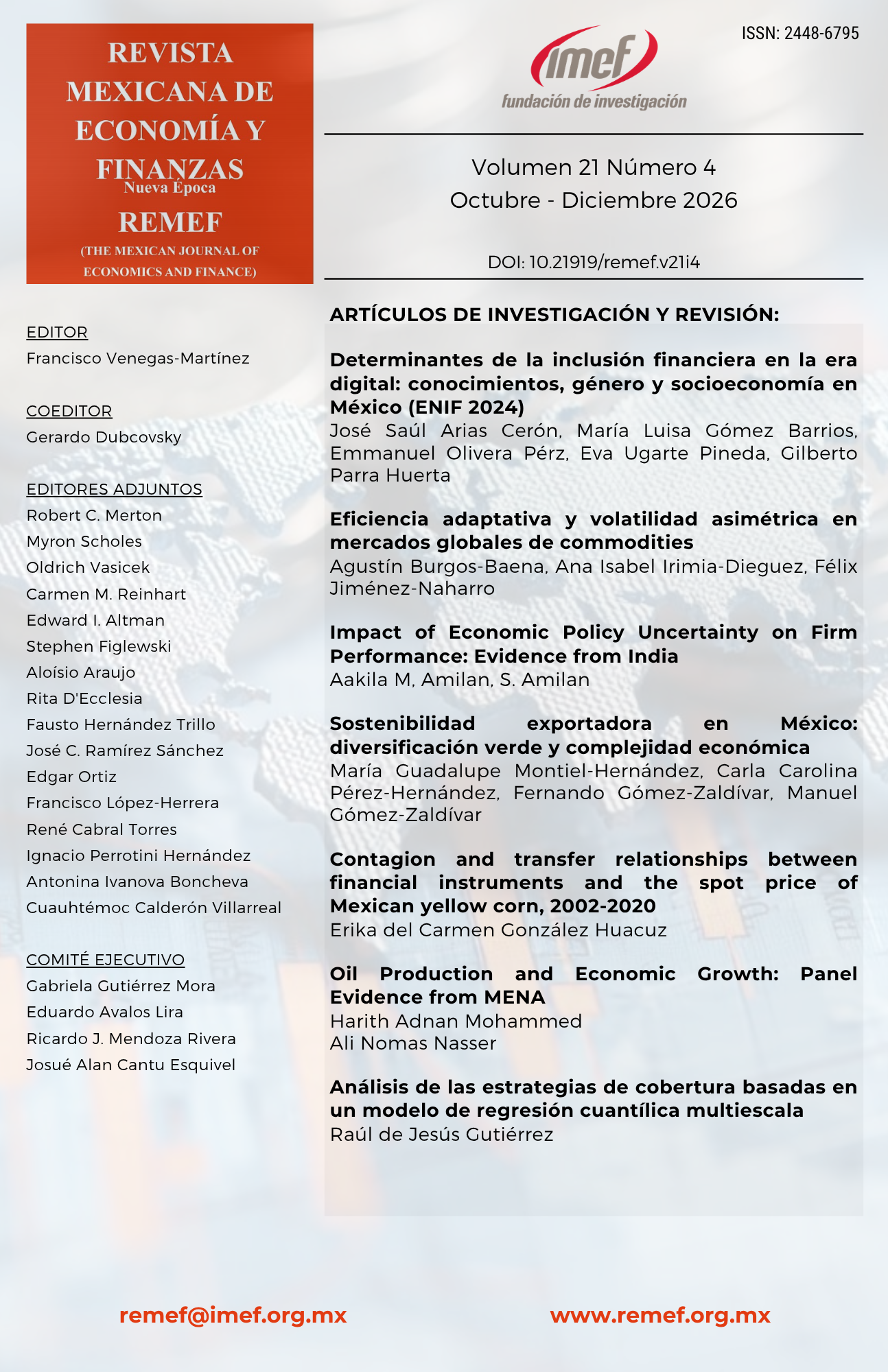
Sostenibilidad exportadora en México: diversificación verde y complejidad económica
DOI:
https://doi.org/10.21919/remef.v21i4.1317Keywords:
Green economy, economic complexity, relatedness, Corporate diversification, corporate sustainabilityAbstract
Sustainable Exports in Mexico: Green diversification and economic complexity
The objective of this study is to identify opportunities for export diversification toward products with environmental benefits in Mexico, contributing to a transition toward a green economy. The methodology is based on the Economic Complexity framework, using indicators such as average exports, revealed comparative advantage, total relatedness, income level associated with products, emission intensity, and product-level GINI inequality. The results identify 57 green products with high potential for the country, grouped according to their feasibility and estimated return. It is recommended that this portfolio be used as input for industrial and trade policy strategies aimed at sustainable exports. Among the limitations are the availability and disaggregation of environmental and social data at the product level. This research is original in its integration of economic, social, and environmental indicators within the analytical framework of economic complexity, broadening its interpretive potential.
References
Alshamsi, A., Pinheiro, F. L., & Hidalgo, C. A. (2018). Optimal diversification strategies in the networks of related products and of related research areas. Nature Communications, 9, 1328. https://doi.org/10.1038/s41467-018-03740-9
Andres, P., & Mealy, P. (2023). Green Transition Navigator. https://green-transition-navigator.org/
Andres, P., Mealy, P., Handler, N., & Fankhauser, S. (2023). Stranded nations? Transition risks and opportunities towards a clean economy. Environmental Research Letters, 18(4), 045004. https://doi.org/10.1088/1748-9326/acc347
Balassa, B. (1965). Trade liberalisation and “revealed” comparative advantage. The Manchester School, 33(2), 99–123. https://doi.org/10.1111/j.1467-9957.1965.tb00050.x
Balland, P.-A., Boschma, R., Crespo, J., & Rigby, D. L. (2019). Smart specialization policy in the European Union: Relatedness, knowledge complexity and regional diversification. Regional Studies, 53(9), 1252–1268. https://doi.org/10.1080/00343404.2018.1437900
Balland, P.-A., Broekel, T., Diodato, D., Giuliani, E., Hausmann, R., O’Clery, N., & Rigby, D. (2022). The new paradigm of economic complexity. Research Policy, 51(3), 104450. https://doi.org/10.1016/j.respol.2021.104450
Barrios, D., Ramos, J., Tapia, J., Grisanti, A., & Morales, J. R. (2018). Baja California: Reporte de complejidad económica.
Belmartino, A. (2022). Green & non-green relatedness: Challenges and diversification opportunities for regional economies in Argentina (GSSI Discussion Paper Series in Regional Science & Economic Geography No. 2022-3).
Boschma, R. (2017). Relatedness as driver of regional diversification: A research agenda. Regional Studies, 51(3), 351–364. https://doi.org/10.1080/00343404.2016.1254767
Boschma, R., & Frenken, K. (2011). The emerging empirics of evolutionary economic geography. Journal of Economic Geography, 11(2), 295–307. https://doi.org/10.1093/jeg/lbq053
Boschma, R., Minondo, A., & Navarro, M. (2013). The emergence of new industries at the regional level in Spain: A proximity approach based on product relatedness. Economic Geography, 89(1), 29–51. https://doi.org/10.1111/j.1944-8287.2012.01170.x
Castañeda, G. (2018). Complejidad económica, estructuras productivas regionales y política industrial. Revista de Economía Mexicana. Anuario UNAM, 3, 144–206.
Chávez, J. C., Mosqueda, M. T., & Gómez-Zaldívar, M. (2017). Economic complexity and regional growth performance: Evidence from the Mexican economy. Review of Regional Studies, 47(2), 201–219. https://doi.org/10.52324/001c.8023
Comisión Nacional del Agua. (2022). Estadísticas del agua en México 2021.
Cooke, P. (2010). Regional innovation systems: Development opportunities from the ‘green turn’. Technology Analysis & Strategic Management, 22(7), 831–844. https://doi.org/10.1080/09537325.2010.511156
Cortinovis, N., Zhang, D., & Boschma, R. (2024). Regional diversification and intra-regional wage inequality in the Netherlands. Regional Studies, 58(12), 2292–2306. https://doi.org/10.1080/00343404.2024.2319339
Economic Commission for Latin America and the Caribbean. (2019). Estudio económico de América Latina y el Caribe 2019: El nuevo contexto financiero mundial: Efectos y mecanismos de transmisión en la región.
Gaulier, G., & Zignago, S. (2010). BACI: International trade database at the product-level (the 1994–2007 version). CEPII Working Paper.
Gómez Zaldívar, F., Molina, E., Flores, M., & Gómez Zaldívar, M. de J. (2019). Complejidad económica de las Zonas Económicas Especiales en México: Oportunidades de diversificación y sofisticación industrial. Ensayos Revista de Economía, 38(1), 1–40. https://doi.org/10.29105/ensayos38.1-1
González Sierra, J. A., Pérez Hernández, C. C., & Mendoza Moheno, J. (2023). Inclusión financiera y complejidad económica en México. Revista Mexicana de Economía y Finanzas Nueva Época, 18(2), e760, 1–25. https://doi.org/10.21919/remef.v18i2.760
Growth Lab. (2024). The Atlas of Economic Complexity. Harvard University. https://atlas.cid.harvard.edu/
Hartmann, D., Bezerra, M., & Pinheiro, F. L. (2019). Identifying smart strategies for economic diversification and inclusive growth in developing economies: The case of Paraguay. SSRN. https://doi.org/10.2139/ssrn.3346790
Hartmann, D., Guevara, M. R., Jara-Figueroa, C., Aristarán, M., & Hidalgo, C. A. (2017). Linking economic complexity, institutions, and income inequality. World Development, 93, 75–93. https://doi.org/10.1016/j.worlddev.2016.12.020
Hausmann, R. (2022). Green growth opportunities.
Hausmann, R., Cheston, T., & Santos, M. A. (2015). La complejidad económica de Chiapas: Análisis de capacidades y posibilidades de diversificación productiva.
Hausmann, R., Hwang, J., & Rodrik, D. (2007). What you export matters. Journal of Economic Growth, 12(1), 1–25. https://doi.org/10.1007/s10887-006-9009-4
Hidalgo, C. A. (2018). From useless to keystone. Nature Physics, 14, 9–10. https://doi.org/10.1038/nphys4337
Hidalgo, C. A. (2021). Economic complexity theory and applications. Nature Reviews Physics, 3(2), 92–113. https://doi.org/10.1038/s42254-020-00275-1
Hidalgo, C. A. (2022). The policy implications of economic complexity [Preprint]. arXiv. https://doi.org/10.48550/arXiv.2205.02164
Hidalgo, C. A. (2023). The policy implications of economic complexity. Research Policy, 52(9), 104863. https://doi.org/10.1016/j.respol.2023.104863
Hidalgo, C. A., & Hausmann, R. (2009). The building blocks of economic complexity. Proceedings of the National Academy of Sciences of the United States of America, 106(26), 10570–10575. https://doi.org/10.1073/pnas.0900943106
Hidalgo, C. A., Klinger, B., Barabási, A.-L., & Hausmann, R. (2007). The product space conditions the development of nations. Science, 317(5837), 482–487. https://doi.org/10.1126/science.1144581
Instituto Nacional de Ecología y Cambio Climático. (2022). Calidad del aire. https://cambioclimatico.gob.mx/estadosymunicipios/Aire.html
Kautish, P., & Sharma, R. (2019). Value orientation, green attitude and green behavioral intentions: An empirical investigation among young consumers. Young Consumers, 20(4), 338–358. https://doi.org/10.1108/YC-11-2018-0881
Mealy, P., & Teytelboym, A. (2022). Economic complexity and the green economy. Research Policy, 51(8), 103948. https://doi.org/10.1016/j.respol.2020.103948
Neffke, F., Henning, M., & Boschma, R. (2011). How do regions diversify over time? Industry relatedness and the development of new growth paths in regions. Economic Geography, 87(3), 237–265. https://doi.org/10.1111/j.1944-8287.2011.01121.x
Organisation for Economic Co-operation and Development. (2021). OECD policy responses to coronavirus (COVID-19). https://www.oecd.org/en/publications/oecd-policy-responses-to-coronavirus-covid-19_5b0fd8cd-en.html
Observatory of Economic Complexity. (2022). Methods. https://oec.world/es/resources/methods#economic-complexity
Observatory of Economic Complexity. (2024). Mexico (MEX): Exports, imports, and trade partners. https://oec.world/es/profile/country/mex
Organisation for Economic Co-operation and Development. (1999). Future liberalisation of trade in environmental goods and services: Ensuring environmental protection as well as economic benefits.
Pérez-Hernández, C. C. (2022). Complejidad económica y economía verde en México: Buscando nuevos caminos para la sustentabilidad.
Pérez-Hernández, C. C., Montiel-Hernández, M. G., & Salazar-Hernández, B. C. (2025). Unlocking green export opportunities: Empirical insights from Southern Cone economies. Sustainability, 17(5), 2257. https://doi.org/10.3390/su17052257
Pérez-Hernández, C. C., Salazar-Hernández, B. C., Mendoza-Moheno, J., Cruz-Coria, E., & Hernández-Calzada, M. A. (2021). Mapping the green product-space in Mexico: From capabilities to green opportunities. Sustainability, 13(2), 945. https://doi.org/10.3390/su13020945
Pinheiro, F. L., Hartmann, D., Boschma, R., & Hidalgo, C. A. (2022). The time and frequency of unrelated diversification. Research Policy, 51(8), 104323. https://doi.org/10.1016/j.respol.2021.104323
Rigby, D. L. (2012). The geography of knowledge relatedness and technological diversification in U.S. cities.
Rigby, D. L., Roesler, C., Kogler, D., Boschma, R., & Balland, P.-A. (2022). Do EU regions benefit from Smart Specialisation principles? Regional Studies, 56(12), 2058–2073. https://doi.org/10.1080/00343404.2022.2032628
Romero, J. P., & Gramkow, C. (2021). Economic complexity and greenhouse gas emissions. World Development, 139, 105317. https://doi.org/10.1016/j.worlddev.2020.105317
Teece, D. J., Pisano, G., & Shuen, A. (1997). Dynamic capabilities and strategic management. Strategic Management Journal, 18(7), 509–533. https://doi.org/10.1002/(SICI)1097-0266(199708)18:7%3C509::AID-SMJ882%3E3.0.CO;2-Z
United Nations Conference on Trade and Development. (2022, December 13). Global trade update: December 2022. https://unctad.org/publication/global-trade-update-december-2022
United Nations Environment Programme. (2023). Green economy. http://www.unep.org/regions/asia-and-pacific/regional-initiatives/supporting-resource-efficiency/green-economy
United Nations Statistics Division. (2024). Classifications on economic statistics. https://unstats.un.org/unsd/classifications/Econ#Correspondences
World Bank. (2024). World Bank Open Data. https://data.worldbank.org/
Downloads
Published
Issue
Section
License
Copyright (c) 2026 Revista Mexicana de Economía y Finanzas Nueva Época REMEF

This work is licensed under a Creative Commons Attribution-NonCommercial 4.0 International License.
Todos los Derechos Reservados © 2019 IMEF | Aviso de Privacidad IMEF | Información Legal

Este obra está bajo una licencia de Creative Commons Reconocimiento-NoComercial 4.0 Internacional.