
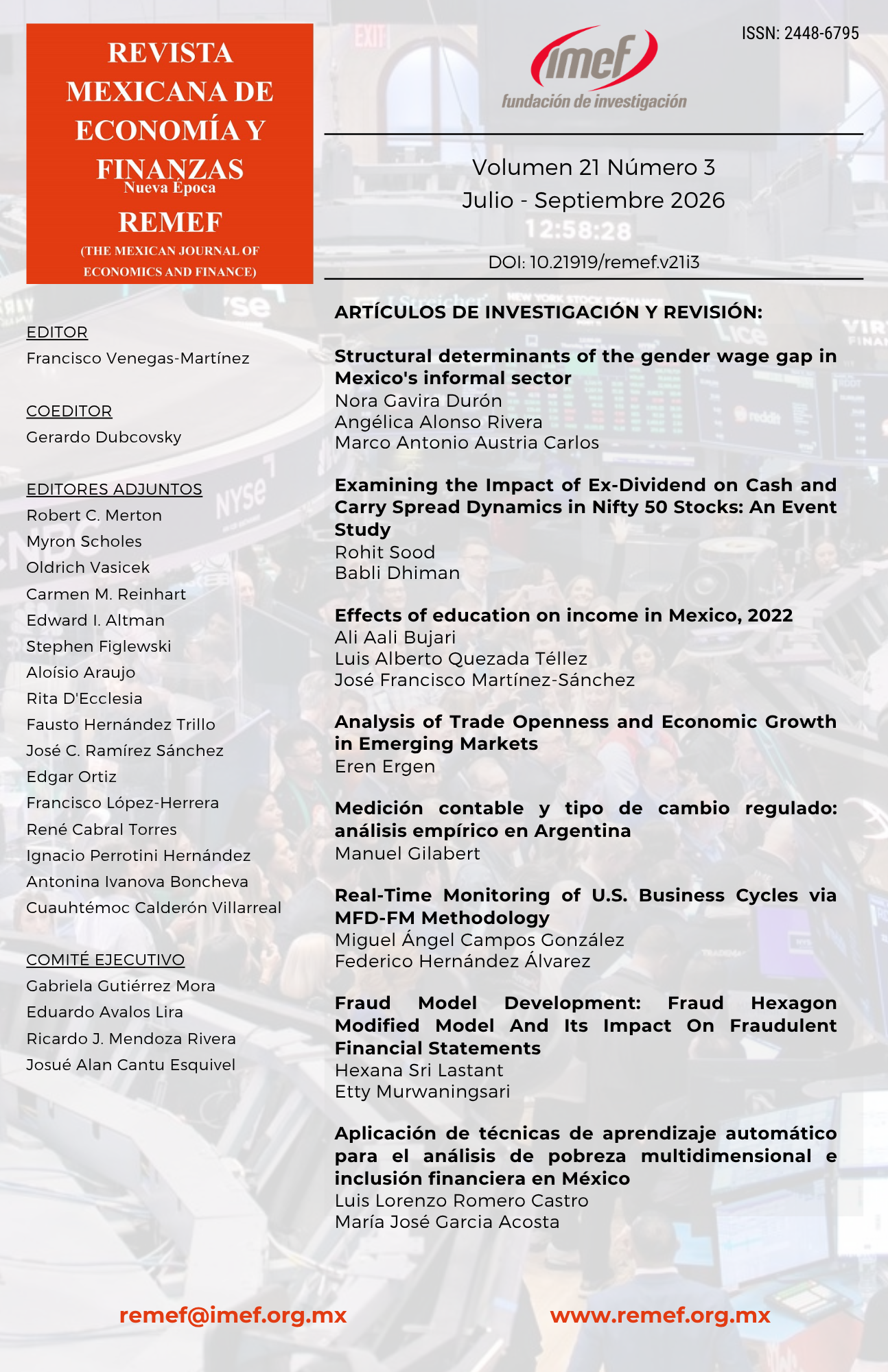
Effects of education on income in Mexico, 2022
DOI:
https://doi.org/10.21919/remef.v21i3.1159Keywords:
dichotomous variables, education returns, Mincer income equationAbstract
The research aims to estimate the education returns of heads of household in Mexico using data from the 2022 National Household Income and Expenditure Survey (ENIGH). Methodology: This study applies the Mincerian income equation and dichotomous variables. Results: Education, experience, and income from overtime work have a positive impact on the household heads’ income, on the other hand, income rises with additional schooling, and higher levels of education contribute more significantly to income. Recommendations: it is suggested that decision- makers implement strategies to promote schooling to increase individual’s income. Limitations: The research is restricted to information on heads of household in Mexico in 2022. Originality: The study uses microdata from ENIGH 2022 with 90102 records, one of the most comprehensive datasets available in recent years. Conclusions: Income increase with levels of schooling.
References
Aali-Bujari, A., Venegas-Martinez, F. & García-Santillán, A. (2019). Schooling Levels and Wage Gains in Mexico. Economics & Sociology, 12(4), 74-83. DOI:10.14254/2071-789X.2019/12-4/4
Attanasio, O. & Costas, M. (2012). Education Choices in Mexico: Using a Structural Model and a Randomized Experiment to Evaluate PROGRESA. The Review of Economic Studies, 79 (1), 37–66. https://doi.org/10.1093/restud/rdr015
Austria-Carlos, M. y Venegas-Martínez, F. (2011). Rendimientos privados de la educación superior en México, 2006. Un modelo de corrección del sesgo por autoselección. Trimestre Económico, 78(2), 441-468. https://www.eltrimestreeconomico.com.mx/index.php/te/article/view/39
Austria-Carlos, M., Venegas-Martínez, F. y Pérez-Lechuga, G. (2018). Diferencias entre géneros en la tasa de ganancia salarial de la educación superior y el posgrado en México. Papeles de Población, 24(96), 157-178. DOI: https://doi.org/10.22185/24487147.2018.96.18
Barceinas, F. (2002). Rendimientos Privados y Sociales de la Educación en México. Economía Mexicana. Nueva Época, XI (2), 333-390. http://hdl.handle.net/11651/1760
Beffy, M., Fougère, D. & Maurel, A. (2012). Choosing the Field of Study in Postsecondary Education: Do Expected Earnings Matter? The Review of Economics and Statistics. 94 (1), 334–347. https://doi.org/10.1162/REST_a_00212
Binelli, C. & Rubio-Codina, M. (2013). The Returns to Private Education: Evidence from Mexico. Economics of Education Review, 36, 198-215. https://doi.org/10.1016/j.econedurev.2013.06.004
Bracho, T. y Zamudio, A. (1994). Los Rendimientos Económicos de la Escolaridad en México, 1989. Economía Mexicana. Nueva Época, III (2), 345-377. https://ideas.repec.org/a/emc/ecomex/v3y1994i2p345-377.html
Brunello, G. & Comi, S. (2004). Education and earnings growth: evidence from 11 European countries. Economics of Education Review, 23 (1), 75-83. https://doi.org/10.1016/S0272-7757(03)00048-7
Cortez, W. (2001). What is Behind Increasing Wage Inequality in Mexico? World Development, 29 (11), 1905-1922. https://doi.org/10.1016/S0305-750X(01)00068-7
Escamilla-Mejía, M., Aali-Bujari, A. & Venegas-Martinez, F. (2023). Obsolescence of Higher Education after 30 Years and its Negative Impact on Economic Growth in OECD Countries. Review of Economics and Finance, 21, 2079-2085. https://doi.org/10.55365/1923.x2023.21.224
Estrada, R. & Gignoux, J. (2017). Benefits to elite schools and the expected returns to education: Evidence from Mexico City. European Economic Review, 95, 168-194. https://doi.org/10.1016/j.euroecorev.2017.03.007
García-Santillán, A. (2023). Financial education in workers in the food sector in Mexico Revista Mexicana de Economía y Finanzas Nueva Época, 18(2), 1-25, e804, https://doi.org/10.21919/remef.v18i1.804
Hartog, J. (2000). Over-education and earnings: where are we, where should we go?. Economics of Education Review, 19 (2), 131-147. https://doi.org/10.1016/S0272-7757(99)00050-3
Hausmann, R., Pietrobelli, C. & Santos, M. (2021). Place-specific determinants of income gaps: New sub-national evidence from Mexico. Journal of Business Research, 131, 782-792. https://doi.org/10.1016/j.jbusres.2021.01.003
Hazarika, G. & Otero, R. (2011). North–South trade liberalization and returns to skill in the south: The case of Mexico. The Journal of International Trade & Economic Development, 20 (4), 449-465. https://doi.org/10.1080/09638190903003028
Herrington, C. (2015). Public education financing, earnings inequality, and intergenerational mobility. Review of Economic Dynamics, 18(4), 822-842. https://doi.org/10.1016/j.red.2015.07.006
Jamison, D. & Van der Gaag, J. (1987). Education and earnings in the People's Republic of China. Economics of Education Review, 6 (2), 161-166. https://doi.org/10.1016/0272-7757(87)90049-5
Kaufmann, K. (2014). Understanding the income gradient in college attendance in Mexico: The role of heterogeneity in expected returns. Quantitative Economics, 5 (3), 583-630. https://doi.org/10.3982/QE259
Kuepie, M., Nordman, C. & Roubaud, F. (2009). Education and earnings in urban West Africa. Journal of Comparative Economics, 37 (3), 491-515. https://doi.org/10.1016/j.jce.2008.09.007
Levison, D., Moe, K. & Knaul, F. (2001). Youth Education and Work in Mexico. World Development, 29 (1), 167-188. https://doi.org/10.1016/S0305-750X(00)00090-5
Levy, S. & López-Calva, L. (2020). Persistent Misallocation and the Returns to Education in Mexico. The World Bank Economic Review, 34 (2), 284–311. https://doi.org/10.1093/wber/lhy017
Mann, A. & Percy, C. (2014). Employer engagement in British secondary education: wage earning outcomes experienced by young adults. Journal of Education and Work, 27 (5), 496-523. https://doi.org/10.1080/13639080.2013.769671
Melissa Binder, M. (1999). Schooling indicators during Mexico's “Lost decade”. Economics of Education Review, 18 (2), 183-199. https://doi.org/10.1016/S0272-7757(98)00028-4
Mincer, J. (1974). Schooling, Experience and Earnings. NBER Working Paper 0053, National Bureau of Economic Research, Inc. https://doi.org/10.2307/2521600
Moock, P., Patrinos, H. & Venkataraman, M. (2003). Education and earnings in a transition economy: the case of Vietnam. Economics of Education Review, 22(5), 503-510. https://doi.org/10.1016/S0272-7757(03)00039-6
Moreno-García, E., Hernández-Mejía, S., & Salazar-Núñez, F.H. (2024). Financial Literacy and Financial Fragility in Mexico. Revista Mexicana de Economía y Finanzas Nueva Época, 19(1), 1-21, e958. https://doi.org/10.21919/remef.v19i1.958
Ortiz-Zarco, R., Aali-Bujari, A. & Rios-Bolívar, H. (2013). Rendimientos Educativos en México, 2010. Un Análisis Empírico. En Ramos, M. & Miranda-García, I. Estudios en Finanzas y Contabilidad: España y América Latina. Estado del arte y las nuevas metodologías aplicadas, 422-433. ECORFAN. https://dialnet.unirioja.es/servlet/articulo?codigo=4776627
Popli, G. (2011). Changes in Human Capital and Wage Inequality in Mexico. Oxford Development Studies, 39 (3), 369-387. https://doi.org/10.1080/13600818.2011.596276
Psacharopoulos, G. (1989). Why educational reforms fail: a comparative analysis. International Review of Education, 35, 179-195. https://link.springer.com/article/10.1007/BF00598437
Psacharopoulos, G. (1994). Returns to investment in education: A global update. World Development, 22(9), 1325-1343. https://doi.org/10.1016/0305-750X(94)90007-8
Psacharopoulos, G., Velez, E., Panagides, A. & Yang, H. (1996). Returns to Education During Economic Boom and Recession: Mexico 1984, 1989 and 1992. Education Economics, 4(3), 219-230. https://doi.org/10.1080/09645299600000022
Quinn, M. & Rubb, S. (2006). Mexico's labor market: The importance of education-occupation matching on wages and productivity in developing countries. Economics of Education Review, 25 (2), 147-156. https://doi.org/10.1016/j.econedurev.2005.01.003
Székely, M., Flores-Ceceña, I., Hevia, F. & Calderón, D. (2024). Measuring learning losses from delayed return to school: Evidence from Mexico. International Journal of Educational Development, 106, 102998. https://doi.org/10.1016/j.ijedudev.2024.102998
Toro, H. (2021). Minding the curve: The influence of social origin on earnings inequality by education in Mexico. The British Journal of Sociology, 72 (5), 1394-1414. https://doi.org/10.1111/1468-4446.12889
Valero-Gil, J. & Valero, M. (2022). Human capital and state income differences in Mexico. Applied Economics, 54 (13), 1544-1561. https://doi.org/10.1080/00036846.2021.1980197
Wei, X, Tsang, M., Xu, W. & Chen, L. (1999). Education and Earnings in Rural China. Education Economics, 7 (2), 167-187. https://doi.org/10.1080/09645299900000014
Weiling, E. (2003). Do returns on investment for educating children in Oaxaca de Juárez, Mexico, pay off? A qualitative analysis. International Journal of Qualitative Studies in Education, 16 (6), 817-834. https://doi.org/10.1080/09518390310001632162
Woodhall, M. (1987). Earnings and Education, Economics of Education Research and Studies, 209-217. https://doi.org/10.1016/B978-0-08-033379-3.50041-3
Downloads
Published
Issue
Section
License
Copyright (c) 2026 Revista Mexicana de Economía y Finanzas Nueva Época REMEF

This work is licensed under a Creative Commons Attribution-NonCommercial 4.0 International License.
Todos los Derechos Reservados © 2019 IMEF | Aviso de Privacidad IMEF | Información Legal

Este obra está bajo una licencia de Creative Commons Reconocimiento-NoComercial 4.0 Internacional.